Grief After Losing Lieve
Nieuwe burenGrief After Losing Lieve is the continuing, unequal sorrow that shapes Peter and Eva’s lives after their daughter’s stillbirth. It does not resolve into a shared or orderly process: Peter tries to set the loss aside, while Eva holds tightly to the memory of Lieve and to her identity as a mother. Their contrasting ways of grieving meet at Lieve’s grave, where care, guilt, jealousy, and the effort to go on occupy the same small patch of ground.
The loss and its persistence
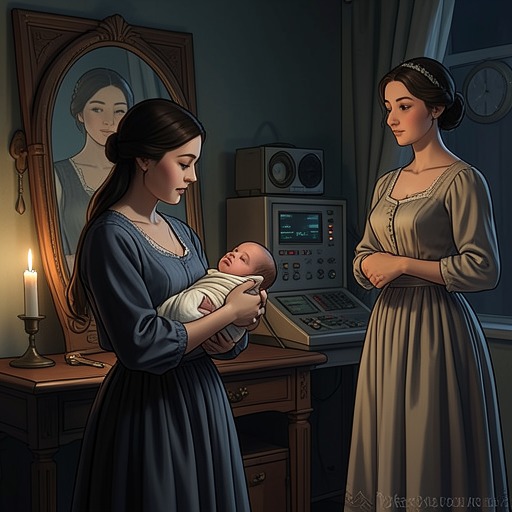
Lieve’s death ends the future Peter and Eva had imagined around their child. They dress her in an outfit they bought together during a weekend in Maastricht and wrap her in a blanket Eva’s mother made from fabric left over from Eva’s own baby clothes. In a transparent bassinet beside Eva’s bed, they look for familiar features in Lieve’s face, touch her fingers and toes, and kiss her cold body. The intimate details of those hours make the loss more than an abstract tragedy: the clothes, inherited cloth, and remembered features are the material traces of a family that had expected to welcome a living child.
The couple choose to take Lieve home and bury her in a place Eva can visit. For a year, Eva goes to the grave every day, sometimes twice in one day. Her visits become so frequent and so visibly painful that a woman who sees her lying there contacts Peter at the newspaper, worried that Eva may be dead or in danger. The episode conveys both the intensity of Eva’s attachment and the difficulty of judging grief from outside: what alarms a passer-by is, for Eva, part of her continued bond with her daughter.
Peter’s effort to contain grief
Peter tells Hetty that the sorrow has begun to recede from his daily consciousness. He and Eva have new friends; he has returned to music and motorcycling, and he thinks they may have found a new balance. Yet being in therapy brings the misery back into view. Hetty reads his apparent recovery differently: she believes he has lost not only Lieve but also the hope of having another child, and that he suppresses his own mourning because he thinks Eva suffers more and has a greater claim to it. She warns that ignored grief will grow more painful rather than disappear.
Peter does not accept that account of what healing must mean. He thinks sorrow may ebb with time and that they should find another way to be content; therapy, in his view, is not for him. His withdrawal from it is not proof that the loss has ceased to matter. At Lieve’s grave he remembers that, since the funeral, he has not gone there with Eva, partly because he cannot face the site as a monument to his failure. When he finally kneels beside the stone and places a white rose there, he wants to feel love for a child he never knew and could not bond with, but instead feels guilt. He also recognizes, with shame, that he is jealous of Eva’s intense sorrow for the dead baby.
Eva’s bond with her daughter
Eva’s grief includes a persistent fear that moving forward will become forgetting. After realizing that she has gone several hours without thinking of Lieve, she is alarmed by the lapse. The memory she guards is precise and physical: Lieve’s fragile body, closed fists, and fine hair. Eva insists inwardly on the fact of her motherhood, even though Lieve was stillborn and she never had the chance to know her as a living child. To her, release risks erasing not only a memory but the relationship that makes her a mother.
A framed photograph and a candle give that bond a place in daily life. Eva wants other people to see the picture as an image of her daughter, not merely of a dead baby. She talks to Lieve in her thoughts, and Hetty’s belief that Lieve was a Star Child whose soul had a higher purpose offers Eva a consoling spiritual interpretation. Eva does not present that belief as a substitute for the child she lost; it is one way of imagining that Lieve remains connected to her. The grave, photograph, and candle make remembrance a practice rather than a single act of farewell.
The anniversary at the grave
On the first anniversary of Lieve’s death, Peter and Eva return together. Eva removes withered flowers while Peter fills a watering can and waters the forget-me-nots. She keeps her jaw tight and avoids his eyes, afraid that speaking will release a scream; he strokes her back and holds her hand. At the grave she kneels, touches the stone, and addresses Lieve as her parents’ child. The scene brings their different responses into contact without making them identical: Peter offers practical care and physical comfort, yet feels the force of his own inadequacy and jealousy beside Eva’s grief.
Eva’s words at the grave trigger Peter’s memory of the morning Lieve died. Eva had woken him in panic, bleeding heavily and convinced they were losing the baby. He searched for the car keys, which were not in their usual place, while she waited with a towel that quickly became soaked. They drove toward the hospital through congestion, over pavements and cycle paths, past red lights; blood stained the car’s beige upholstery. The anniversary does not merely recall a date. It brings back the confusion, delay, and terror of that morning with the sharpness of an event still present to Peter.
At the end of the visit, Eva tells Lieve that her parents must go on, but that she remains in their hearts: she will always be Lieve’s mother, and Lieve will always be their daughter. Eva kisses the stone and leaves a small stone angel among the flowers, entrusting it with watching over Lieve when she is absent. Peter can admire Eva’s capacity to believe that Lieve is an angel who still surrounds them, but cannot share that belief. Their farewell therefore preserves a difference as well as a bond: Eva’s faith comforts her, while Peter remains outside it.
Grief alongside ordinary life
The narrative places mourning beside activities that continue, without suggesting that one cancels the other. Peter’s music, motorcycle rides, friendships, and work coexist with the pain that returns in therapy and at the grave. Eva also returns to work with young children. In a later period of anxious uncertainty, she notices tense breasts and nausea at the smell of coffee, avoids running, cycling, and bumpy roads, and tells herself that pregnancy would be a miracle, though she knows the chance is very small. Her work with children, by contrast, is a daily source of vitality: their noise and movement do not overwhelm her; after seeing a dead child, she cherishes their liveliness.
These moments resist a simple distinction between remembering and recovering. Peter’s attempt to carry on can look like distance from Lieve, while Eva’s devotion can make the demand to let go feel like a threat to her motherhood. The couple do find ways to resume daily life, but neither the grave visit nor the anniversary closes the loss. Their grief remains active in memory, bodily fear, work, and the different meanings each can make of continuing.